
Risk management in large-scale solar power plant projects is a systematic and continuous process implemented in accordance with international standards (such as PMBOK and the guidelines of SolarPower Europe). At aSun Energy Faragir, this process is not treated merely as a theoretical requirement, but rather as a core pillar of success for megawatt-scale projects. Our approach is based on proactive risk identification, quantitative assessment, active mitigation, and real-time monitoring of risks to ensure project delivery on schedule, within the defined budget, and with guaranteed quality.
Key Stages of Risk Management at aSun Energy
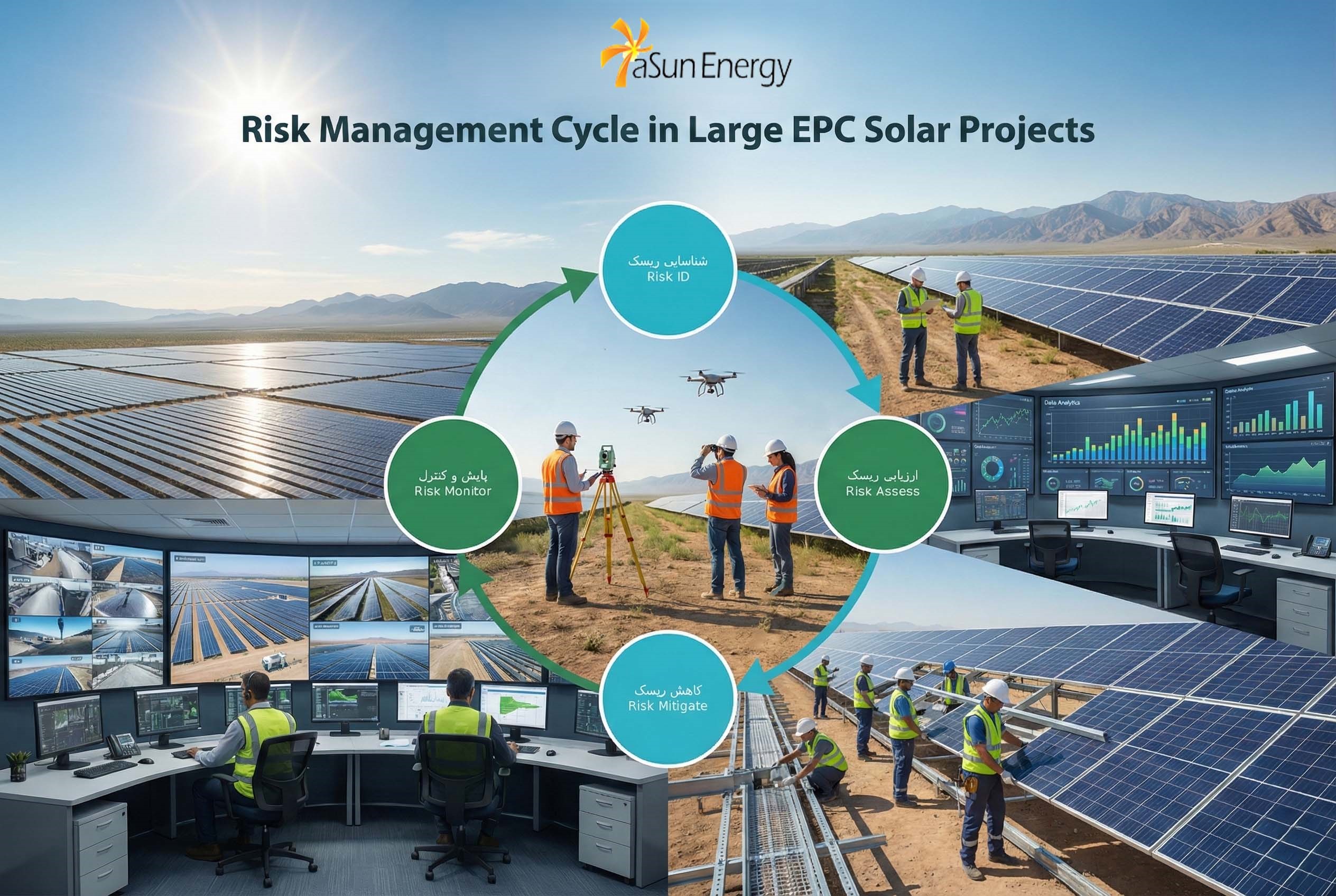
Risk Identification
By establishing a Risk Committee composed of senior technical, financial, and legal managers, we identify risks at the earliest stages of feasibility studies. For example, in the Mobarakeh project, the following key risks were identified and categorized prior to execution:
- Technical Risks: Reduction in solar panel efficiency due to dust accumulation, thermal stress during hot summers, and the risk of premature inverter failures.
- Financial Risks: Exchange rate volatility (given the imported nature of some equipment), increases in bank loan interest rates, and potential changes in feed-in tariff or PPA rates.
- Legal and Contractual Risks: Delays in obtaining grid connection permits from SATBA, changes in environmental regulations, and differing interpretations of EPC contract clauses.
- Execution Risks: Delays in equipment transportation from international suppliers, shortages of skilled local labor, and unforeseen weather conditions.
Risk Assessment
Identified risks are quantitatively assessed using the Probability–Impact Matrix as well as Failure Mode and Effects Analysis (FMEA). At this stage, each risk is ranked based on its likelihood of occurrence (from low to high) and the severity of its impact on time, cost, and quality. For instance, the risk of “delay in issuing grid connection permits” in Iranian projects is often classified as a medium-probability but high-impact risk, requiring an immediate response plan.
Risk Mitigation and Control
For each high-priority risk, a specific response plan is developed. Our solutions typically combine the four core strategies of avoidance, transfer, mitigation, and acceptance:
- Financial Risk Transfer: Executing fixed-price equipment procurement contracts in predefined currencies with reputable international suppliers, along with the use of performance and advance payment guarantees to cover counterparty risks.
- Technical Risk Mitigation: Selecting panels and inverters with long-term performance warranties (e.g., 12 years for product warranty and 25 years for linear performance). Conducting detailed simulations using PVsyst software prior to execution to forecast energy production under various climatic conditions.
- Execution Risk Mitigation: Supply chain planning with safety stock for critical components and contracting reliable local contractors with delay penalty clauses.
- Practical Example – Aradan Project: The risk of delays caused by specific regional conditions was fully controlled through permanent on-site deployment of the technical team and the implementation of an alternative two-shift working plan, resulting in project delivery ahead of schedule.
Continuous Monitoring and Review
Risk management is not a static process. By utilizing project management dashboards such as Primavera P6 and holding weekly risk review meetings, we continuously monitor identified risks and register new ones as they arise. Monthly risk status reports, together with key performance indicators (KPIs), are provided to the client to ensure full transparency.
Conclusion
At aSun Energy, we believe that effective risk management is the most critical factor in building trust and confidence among investors and employers of large-scale solar projects. Our systematic approach—shaped by global standards and reinforced by local experience—ensures the delivery of projects that are not only technically flawless, but also economically optimized and predictably scheduled. We are committed to managing your project risks with the same rigor and precision applied in our own projects, maximizing the value of your solar energy investment.